
How is stem cell treatment for knee pain done?
At Stem Cell Mexico, stem cell treatment for knee pain is a minimally invasive outpatient-style procedure with a short stay.
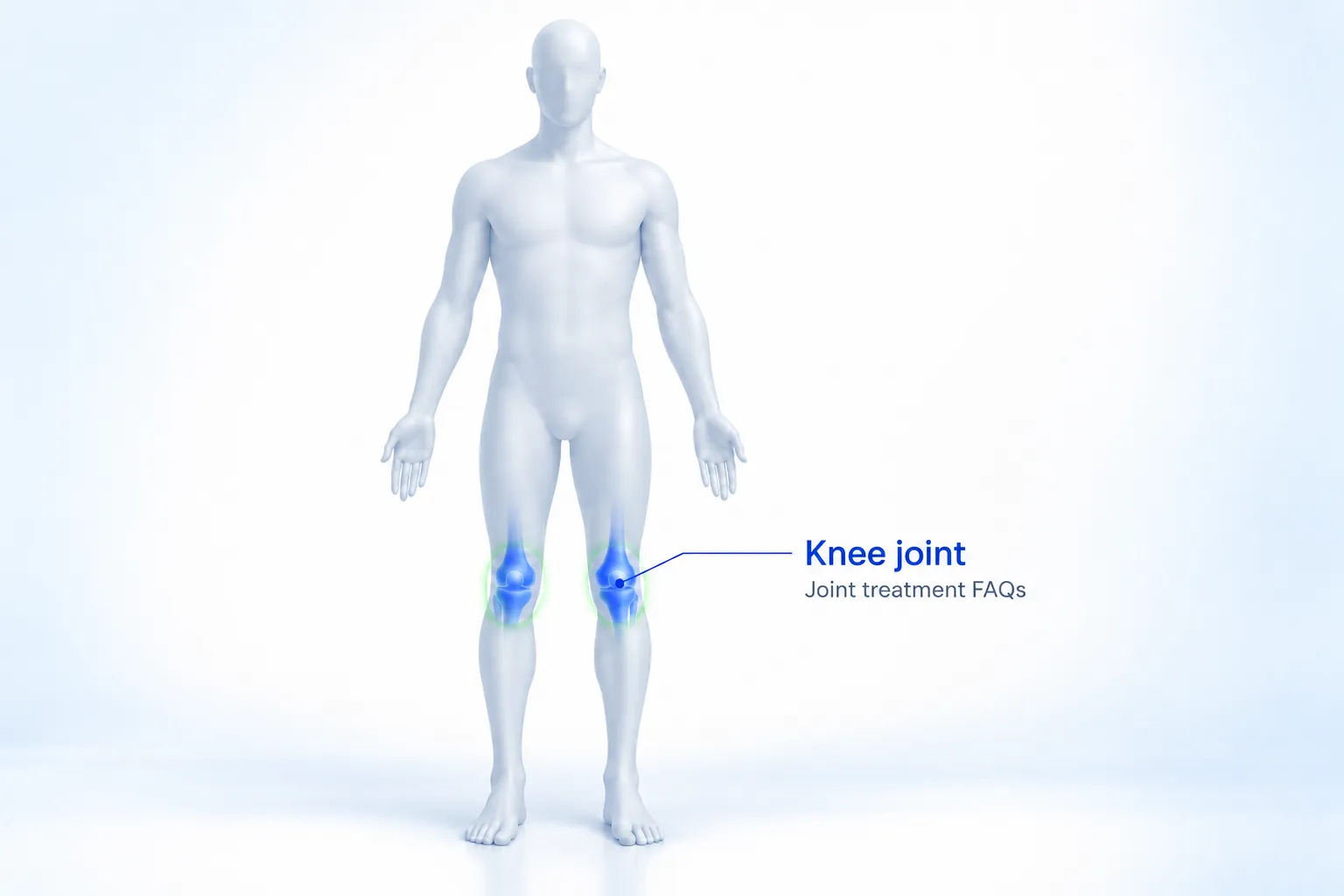
It begins with a medical questionnaire, a review of your knee X-rays or MRI and a phone or video consultation with the doctor, continues with a written plan and an in-person evaluation, and centers on an ultrasound-guided injection of allogeneic mesenchymal stem cells (MSCs) from Wharton's jelly of the umbilical cord into the knee joint, usually 20 to 40 million cells per knee, often together with platelet-rich plasma (PRP) prepared from your own blood. The application takes less than an hour under local anesthesia, followed by a night at our facilities with nursing and medical monitoring, a progressive activity plan and follow-up calls. One knee typically costs $3,900 to $6,000 USD, and both knees typically $6,000 to $9,000 USD. Results vary from patient to patient, and treatment works best combined with strengthening exercise.
This guide walks you through every step, from your first message to the months after treatment.
A typical itinerary
- Day 1: pickup in the San Diego airport area, border crossing with our driver, laboratory tests and in-person evaluation with the doctor, then the knee application and a night at our facilities.
- Day 2: check-up with the doctor, discharge instructions and return to San Diego, usually in time for an afternoon or evening flight.
Some plans use a slightly different schedule; the exact itinerary is confirmed in your written plan.
Step 1: Medical questionnaire and imaging
You complete a short medical questionnaire and send your imaging:
- X-rays, ideally standing views of the knee, and/or an MRI. The MRI should be no older than three months, so the doctor sees the current state of the joint.
- Reports from your orthopedic doctor or physical therapist, if available.
- Previous treatments: cortisone, hyaluronic acid or PRP injections and any knee surgery, with dates.
- Medications, especially blood thinners and anti-inflammatory drugs.
If you do not have recent imaging, an MRI can be arranged in Tijuana before your evaluation.
Step 2: Consultation with the doctor
A complimentary phone or video consultation allows the doctor to review your imaging, understand your symptoms and goals and explain what regenerative treatment can offer for your knee. The doctor confirms whether you are a candidate, how many cells are recommended, whether one or both knees should be treated and whether PRP or treatment of structures around the joint, such as the meniscus or tendons, is advisable.
Step 3: Written plan and preparation
You then receive a written plan by email. It typically lists the number of cells and the knee or knees to be treated, PRP when included, the night at our facilities, the consultation with your doctor and the stem cell specialist, ground transportation and the total price, with the deposit that reserves your date.
Typical preparation instructions include:
- Pausing anti-inflammatory painkillers, alcohol, tobacco and cannabis for about seven days before treatment, and supplements such as omega 3, turmeric and ginger for about five days before, as the doctor indicates.
- Avoiding cortisone injections in the knee in the weeks before treatment, as the doctor indicates.
- Reviewing blood thinners with the doctor and your prescribing physician; they are never stopped without medical guidance.
- Wearing comfortable clothes, such as shorts or loose pants, on the day of the procedure.
- Planning a companion for the trip if possible, especially if both knees will be treated.
Step 4: Arrival and evaluation
On arrival, you have blood tests and an in-person evaluation. The doctor examines your knee, reviews your imaging and confirms the plan. Treatment is postponed if there is an infection, a very swollen knee that needs to be drained first or any other reason it would not be safe that day.
Step 5: The procedure
PRP preparation
If PRP is included, a small amount of blood is drawn from your arm and processed in a centrifuge to concentrate the platelets.
The application
- You lie on the procedure table with the knee slightly bent and supported.
- The skin is cleaned with antiseptic and covered with sterile drapes.
- A local anesthetic numbs the skin and the path of the needle.
- Using ultrasound guidance, the doctor visualizes the joint space and guides a thin needle into the knee.
- If the knee has excess fluid, it may be drained first.
- The Wharton's jelly MSCs and, when included, the PRP are injected into the joint and, if planned, into structures such as the meniscus or tendons.
- A small dressing is applied.
The application usually takes 20 to 40 minutes per knee. Ultrasound guidance helps place the cells precisely where they are intended, and it allows the doctor to see the joint space, the fluid and the surrounding structures in real time.
The cells
The cells are allogeneic MSCs from Wharton's jelly of donated umbilical cords, obtained after healthy, full-term births with the mother's informed consent and donor screening. They are prepared in a COFEPRIS-licensed laboratory under Good Manufacturing Practice standards, with quality and safety testing before release. Stem Cell Mexico uses only this cell type.
Step 6: Observation
You spend the night at our facilities with nursing and medical monitoring. The team checks your knee, vital signs and comfort, and helps you with ice and positioning.
Step 7: Discharge and early recovery
Before discharge, the doctor reviews your knee and gives written instructions:
- Soreness, swelling or stiffness for three to seven days is common and expected.
- Ice for 15 to 20 minutes several times a day and paracetamol (acetaminophen) as directed; avoid anti-inflammatory painkillers for the period the doctor indicates.
- Walking is usually allowed the same day; a cane can help for a few days if the knee feels sore.
- Avoid running, jumping, heavy lifting and long hikes for the first weeks.
- Travel: on the flight home, stand and walk periodically and keep the leg moving.
Contact the clinic or seek care for fever, increasing redness, heat or swelling after the first days, or inability to bear weight. These complications are rare, and the instructions help detect them early.
Step 8: Rehabilitation
A progressive plan supports your result:
- Week 1: gentle range of motion, short walks and ice.
- Weeks 2 to 6: strengthening of the quadriceps, hamstrings and hip muscles with a physical therapist or home program, plus low-impact exercise such as stationary cycling or swimming.
- Weeks 6 to 12 and beyond: progressive return to longer walks, hiking, golf or sport, guided by comfort and strength.
The NICE guideline on osteoarthritis (NG226) emphasizes exercise and weight management as the foundation of knee care, and these remain essential after regenerative treatment.
Step 9: Follow-up
Our team stays in contact through follow-up calls and messages. Based on what patients tell us, many begin to notice improvement within a few days to a few weeks, while others improve more gradually over the following months. We recommend recording your pain and function at one, three, six and twelve months. Based on your progress, the doctor may recommend a PRP session or a second application.
Treating both knees
Many patients have osteoarthritis in both knees. Both can usually be treated during the same visit, which saves travel and is priced as a multiple-joint plan, typically $6,000 to $9,000 USD. Treating both knees at once means both may be sore for a few days, so walking aids and a companion are especially helpful. If one knee is much worse, or if your mobility is already limited, the doctor may suggest treating the more affected knee first and the other on a later visit. The decision is made with you during the consultation, based on your imaging, symptoms and plans for the weeks after treatment.
What the evidence shows
A 2024 meta-analysis of randomized controlled trials in the Journal of Orthopaedic Translation found that MSC injections reduced knee pain more than hyaluronic acid at 12 months and improved function, with a favorable safety profile. A randomized trial of umbilical cord MSCs in Stem Cells Translational Medicine found significantly better pain and function scores at 12 months than hyaluronic acid.
Questions to ask during your evaluation
- Should one or both knees be treated?
- Will PRP be included, and will the meniscus or tendons be treated?
- How long should I wait after a recent cortisone injection?
- When can I return to my sport or activity?
- How will we measure progress?
Bottom line
Stem cell treatment for knee pain at Stem Cell Mexico follows a clear process: questionnaire and imaging review, consultation, written plan, in-person evaluation, ultrasound-guided injection of Wharton's jelly MSCs, often with PRP, a night of observation, a progressive rehabilitation plan and follow-up. Results vary from patient to patient. A medical evaluation can help determine whether this type of regenerative treatment is appropriate for your knee, goals and medical history.
References
- Tabet CG et al. Advanced therapy with mesenchymal stromal cells for knee osteoarthritis: systematic review and meta-analysis of randomized controlled trials. Journal of Orthopaedic Translation, 2024 (opens in a new tab)
- Matas J et al. Umbilical cord-derived mesenchymal stromal cells (MSCs) for knee osteoarthritis: repeated MSC dosing is superior to a single MSC dose and to hyaluronic acid in a controlled randomized phase I/II trial. Stem Cells Translational Medicine, 2019 (opens in a new tab)
- NICE guideline NG226: Osteoarthritis in over 16s, diagnosis and management (opens in a new tab)