
How effective is stem cell therapy for knee pain?
Stem cell therapy is one of the most effective regenerative options for knee pain, especially for mild to moderate osteoarthritis, where the evidence is strongest.
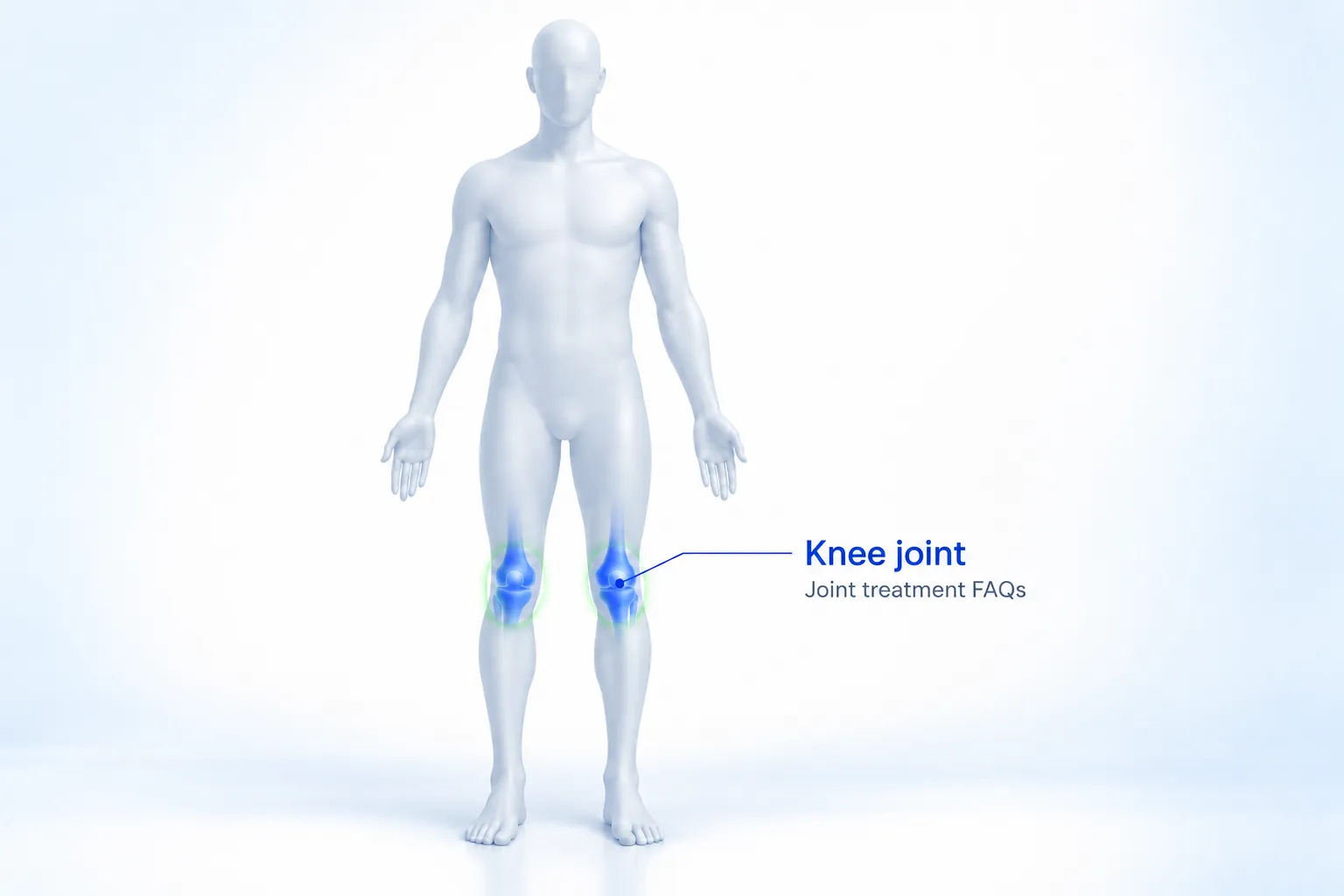
A 2024 systematic review and meta-analysis of randomized controlled trials in the Journal of Orthopaedic Translation found that mesenchymal stem cell (MSC) injections reduced pain more than hyaluronic acid at 12 months and improved function on WOMAC scores, with no difference in serious adverse events compared with control treatments. A randomized trial of umbilical cord MSCs in Stem Cells Translational Medicine reported significantly better pain and function scores at 12 months than hyaluronic acid. Knee treatment is also the most frequent regenerative procedure our team plans. At Stem Cell Mexico, knee protocols use only allogeneic MSCs from Wharton's jelly of the umbilical cord, applied with ultrasound guidance and often combined with platelet-rich plasma (PRP). Effectiveness depends on the stage of the knee, body weight and rehabilitation, and results vary from patient to patient.
This guide explains how knee results are measured, what to expect at each stage of osteoarthritis, how long benefits tend to last and how to get the most from treatment.
How knee results are measured
- Pain scales (VAS or NRS): from 0 (no pain) to 10 or 100 (worst pain), at rest and during activity.
- WOMAC index: scores pain, stiffness and physical function in knee and hip osteoarthritis.
- KOOS: measures symptoms, daily activities, sports, recreation and knee-related quality of life.
- Functional tests: walking distance, stair climbing, rising from a chair and timed walking tests.
- Medication use: whether you can reduce painkillers or anti-inflammatory drugs.
- Imaging: MRI can show changes in inflammation and cartilage, although images do not always match how the knee feels.
The most meaningful measures for most patients are personal: walking without stopping, sleeping without night pain or returning to a favorite activity.
What the trials show
- Pain: MSC injections reduced pain more than hyaluronic acid at 12 months in pooled randomized trials.
- Function: WOMAC function scores improved, reflecting easier walking, stairs and daily activities.
- Umbilical cord cells: in a randomized trial, repeated umbilical cord MSC injections produced significantly better pain and function scores at 12 months than hyaluronic acid.
- Safety: serious adverse events were similar to control treatments; temporary pain, swelling or stiffness for a few days was the most common effect.
What to expect by stage of osteoarthritis
Doctors grade knee osteoarthritis on X-rays with the Kellgren-Lawrence (KL) scale:
| KL grade | What it means | What regenerative treatment can usually offer |
|---|---|---|
| 1 to 2 | Early changes, cartilage mostly preserved | Good opportunity to reduce pain and protect the joint |
| 3 | Moderate narrowing of the joint space | The group most studied in trials; meaningful pain and function improvement is common |
| 4 | Bone-on-bone, often with deformity | More modest benefit; knee replacement may be the better long-term option |
Your doctor uses your X-rays or MRI to place you in one of these groups and explain what is realistic for your knee. Standing X-rays are especially useful, because they show how much space remains between the bones when the knee carries your weight. If you only have an MRI, it also shows the cartilage, meniscus and inflammation, which helps the doctor plan the injection.
Knee pain from causes other than osteoarthritis
- Degenerative meniscus tears: often treated together with osteoarthritis; regenerative treatment can target the joint and, when indicated, the meniscus under ultrasound guidance.
- Patellar and quadriceps tendinopathy: injections can be directed to the tendon, combined with a loading program.
- Partial ligament injuries: may be treated when the knee is stable; complete ruptures usually need surgical evaluation.
- Patellofemoral pain: often improves with targeted strengthening; injections are considered when cartilage behind the kneecap is affected.
What patients commonly report
When treatment works well, patients usually describe practical gains: walking longer, climbing stairs with less pain, getting up from a chair more easily, less morning stiffness, better sleep and fewer painkillers. Some notice improvement at rest first and during sport later. Others improve more modestly, which is why comparing your own goals and scores before and after treatment matters.
How long results last
In published trials, follow-up commonly extends to one or two years, and many patients maintain improvement throughout that period. Some maintain benefit longer, while others choose a PRP session or a second cell application after a year or more. Durability depends on the stage of osteoarthritis, body weight, muscle strength and activity level.
A typical timeline
- Days 1 to 7: soreness, swelling or stiffness in the knee is common and does not predict the final result.
- Weeks 1 to 4: based on what patients tell us, many begin to notice less pain and stiffness.
- Months 1 to 6: gradual improvement as you progress with exercise.
- Months 6 to 12: the period when most trials measure their main results.
How it compares with other knee injections
| Treatment | How it works | Typical duration of relief |
|---|---|---|
| Corticosteroid | Rapidly suppresses inflammation | Weeks to a few months |
| Hyaluronic acid | Adds lubrication to the joint | Variable, often a few months |
| PRP | Delivers your own growth factors | Several months to about a year |
| MSCs, often with PRP | Anti-inflammatory and trophic signaling | Trials commonly follow patients for one to two years |
The NICE guideline on osteoarthritis (NG226) places exercise, weight management and education at the center of knee care, and regenerative treatment works best combined with those measures.
Factors that influence effectiveness
- Stage of osteoarthritis: the earlier, the greater the opportunity.
- Body weight: lower load on the knee supports better and longer-lasting results.
- Alignment: a knee that is very bowed or knock-kneed concentrates load on one side.
- Muscle strength: strong quadriceps and hip muscles protect the joint.
- Associated problems: meniscus tears, loose bodies or ligament instability may need separate attention.
- Recent cortisone injections: steroids can affect cells, so the doctor reviews the timing.
- General health: smoking, diabetes and inflammatory conditions affect healing.
- Footwear and daily habits: supportive shoes, pacing activity and avoiding long periods of kneeling or deep squatting reduce strain on the knee.
What our patients usually receive
Based on the treatment plans our team prepares for knee patients, a typical protocol at Stem Cell Mexico includes:
- 20 to 40 million Wharton's jelly MSCs per knee, applied into the joint by direct injection with ultrasound guidance.
- Platelet-rich plasma (PRP) in many plans, applied together with the cells.
- One night at our facilities with nursing and medical monitoring.
- Consultation with your doctor and the stem cell specialist, pre-treatment laboratory tests and ground transportation from the San Diego airport area.
- Your recent imaging: an MRI of the area no older than three months is requested.
One knee typically costs $3,900 to $6,000 USD, and both knees typically $6,000 to $9,000 USD. Our team stays in contact after treatment to follow your progress and decide whether a second application or a PRP session could help.
How to get the most from treatment
- Bring recent imaging so your knee can be staged accurately.
- Write down two or three goals, such as walking 30 minutes or climbing stairs without pain.
- Follow the activity plan: relative rest for a few days, then progressive loading.
- Start a strengthening program with a physical therapist after the first week or as the doctor indicates.
- Manage weight and choose low-impact exercise.
- Record your pain and function at one, three, six and twelve months.
Who may be a candidate
- Mild to moderate knee osteoarthritis or degenerative meniscus problems confirmed by imaging.
- Pain that has not improved enough with exercise, physical therapy or medications.
- No active infection in the knee and no cancer within the past five years.
- Willingness to follow a rehabilitation program.
Questions to ask during your evaluation
- What Kellgren-Lawrence grade is my knee?
- What improvement is realistic for my stage?
- Will PRP be included, and how many cells are recommended?
- How long should I wait after a recent cortisone injection?
- How will we measure my results?
Bottom line
Stem cell therapy is effective for many people with knee pain, with the strongest evidence in mild to moderate osteoarthritis: randomized trials show greater pain relief and better function than hyaluronic acid at 12 months and a favorable safety profile. At Stem Cell Mexico, Wharton's jelly MSCs, often combined with PRP, are applied with ultrasound guidance as part of a plan that includes exercise and follow-up, and results vary from patient to patient. A medical evaluation can help determine whether this type of regenerative treatment is appropriate for your knee, goals and medical history.
References
- Tabet CG et al. Advanced therapy with mesenchymal stromal cells for knee osteoarthritis: systematic review and meta-analysis of randomized controlled trials. Journal of Orthopaedic Translation, 2024 (opens in a new tab)
- Matas J et al. Umbilical cord-derived mesenchymal stromal cells (MSCs) for knee osteoarthritis: repeated MSC dosing is superior to a single MSC dose and to hyaluronic acid in a controlled randomized phase I/II trial. Stem Cells Translational Medicine, 2019 (opens in a new tab)
- NICE guideline NG226: Osteoarthritis in over 16s, diagnosis and management (opens in a new tab)