
Does stem cell therapy cure knee pain?
Stem cell therapy does not cure knee pain in the sense of returning a worn knee to its original condition, but it can reduce pain, improve function and, for many people with mild to moderate osteoarthritis, help postpone knee replacement.
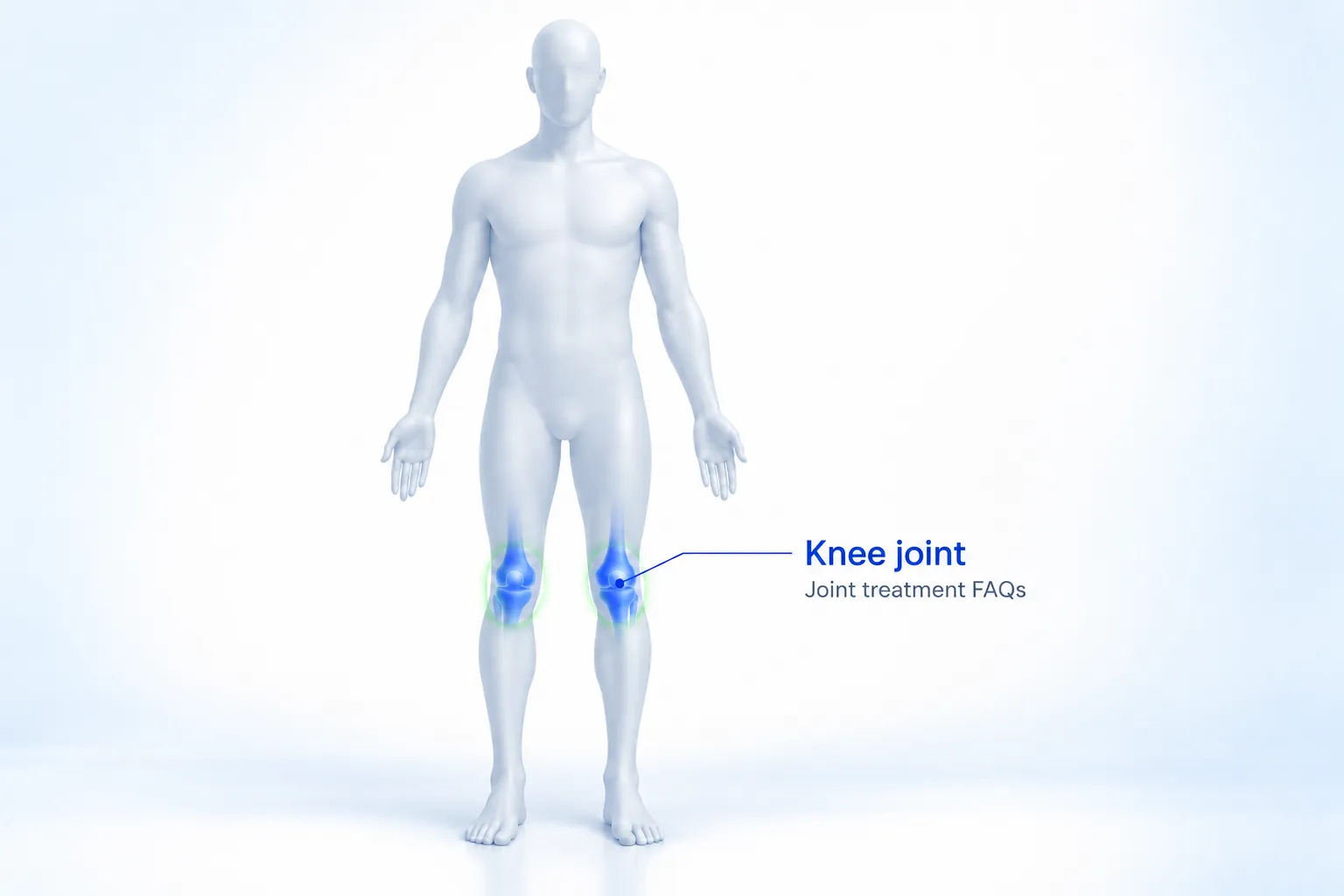
The evidence for the knee is the strongest in regenerative orthopedics: a 2024 meta-analysis of randomized controlled trials found that mesenchymal stem cell (MSC) injections reduced pain more than hyaluronic acid at 12 months and improved function, and a randomized trial of umbilical cord MSCs reported significantly better pain and function scores at 12 months than hyaluronic acid, with no serious adverse events attributed to the cells. At Stem Cell Mexico, knee protocols use only allogeneic MSCs from Wharton's jelly of the umbilical cord, usually 20 to 40 million cells applied into the joint with ultrasound guidance, often together with platelet-rich plasma (PRP). One knee typically costs $3,900 to $6,000 USD. Results vary with the stage of the knee, body weight and rehabilitation.
This guide explains where knee pain comes from, what regenerative treatment can realistically change and how to decide whether it fits your situation.
Where knee pain comes from
The knee is the largest joint in the body and carries several times your body weight with every step and stair. Pain can come from several structures:
- Osteoarthritis: gradual loss of the cartilage that covers the ends of the bones, with changes in the underlying bone and inflammation of the joint lining. It is the most common cause of chronic knee pain after 45.
- Meniscus tears: the two C-shaped cushions inside the knee can tear with injury or wear, causing pain, swelling and catching.
- Ligament injuries: the ACL, MCL and other ligaments stabilize the knee; partial injuries can cause ongoing pain and instability.
- Patellofemoral pain: pain around or behind the kneecap, common in runners and people who climb stairs or squat often.
- Tendinopathies: patellar and quadriceps tendon problems, common in jumping sports.
- Inflammatory arthritis: such as rheumatoid arthritis, which requires specific medical treatment.
Identifying the source is the first step, because each cause has its own best treatment. Often more than one structure is involved, for example osteoarthritis together with a degenerative meniscus.
Why worn cartilage does not grow back fully
Adult cartilage has no blood supply and very few cells, so it has very limited ability to repair itself. Once osteoarthritis has thinned the cartilage and changed the shape of the bone, those changes do not reverse completely with any current treatment. This is why the goal of knee care, whether with exercise, injections or regenerative treatment, is to reduce pain, improve function, protect the joint and delay or avoid surgery.
What regenerative treatment can change
MSCs from Wharton's jelly act through paracrine signaling. Inside the knee, the signals they release may:
- Calm inflammation of the synovial membrane, an important source of pain and swelling in osteoarthritis.
- Modulate pain signaling.
- Support the remaining cartilage cells and slow further breakdown.
- Support the healing of the meniscus and surrounding tendons in some cases.
PRP, prepared from your own blood, adds concentrated growth factors and is often combined with the cells.
For patients, these effects usually mean less pain when walking and climbing stairs, less stiffness, better sleep and more confidence in daily activities and exercise.
What the evidence shows
- Meta-analysis, Journal of Orthopaedic Translation, 2024: randomized controlled trials of MSCs for knee osteoarthritis showed greater pain reduction than hyaluronic acid at 12 months and improvements in WOMAC function scores, with no difference in serious adverse events compared with control treatments.
- Umbilical cord MSCs, Stem Cells Translational Medicine: a randomized controlled phase I/II trial found that patients who received repeated umbilical cord MSC injections had significantly better pain and function scores at 12 months than those who received hyaluronic acid.
- Safety: the most common effects are temporary pain, swelling or stiffness in the knee for a few days.
Results patients commonly describe
When treatment works well, patients usually describe practical changes: walking longer without stopping, climbing stairs with less pain, getting up from a chair more easily, sleeping without night pain and returning to activities such as golf, hiking or playing with grandchildren. Many also reduce their use of painkillers. Tracking these activities before and after treatment is the simplest way to see your own result.
Can it help me avoid a knee replacement?
For many people with mild to moderate osteoarthritis (Kellgren-Lawrence grades 2 to 3), regenerative treatment can reduce pain enough to postpone surgery, sometimes for years, especially when combined with exercise and weight management. For people with advanced, bone-on-bone osteoarthritis and major deformity, the chance of meaningful benefit is lower, and knee replacement may be the best long-term option. The doctor reviews your X-rays or MRI to tell you which group you are in.
How it fits with other knee treatments
The NICE guideline on osteoarthritis (NG226) recommends exercise, weight management and education as the foundation of knee care, with topical or oral anti-inflammatory medication when needed. Other options include physical therapy, bracing, corticosteroid injections for short-term relief, hyaluronic acid, PRP and, for advanced disease, knee replacement. Regenerative treatment sits between conservative care and surgery, and it works best when combined with a strengthening program.
What our patients usually receive
Based on the treatment plans our team prepares for knee patients, a typical protocol at Stem Cell Mexico includes:
- 20 to 40 million Wharton's jelly MSCs per knee, applied into the joint by direct injection with ultrasound guidance.
- Platelet-rich plasma (PRP) in many plans, applied together with the cells.
- One night at our facilities with nursing and medical monitoring.
- Consultation with your doctor and the stem cell specialist, pre-treatment laboratory tests and ground transportation from the San Diego airport area.
- Your recent imaging: an MRI of the area no older than three months is requested.
One knee typically costs $3,900 to $6,000 USD, and both knees are priced as a multiple-joint plan, typically $6,000 to $9,000 USD.
Based on what patients tell us, many begin to notice improvement within a few days to a few weeks after the application, while others improve more gradually over the following months. Our team stays in contact after treatment to follow your progress and decide whether a second application or a PRP session could help.
What you can do to protect your knee
Regenerative treatment works best in a knee that is supported by strong muscles and reasonable loads. These measures help on their own and support any treatment:
- Strengthen the quadriceps, hamstrings and hip muscles, which absorb load before it reaches the cartilage.
- Choose low-impact activity, such as cycling, swimming, walking on flat ground or elliptical training.
- Manage your weight: each kilogram lost reduces the load on the knee several times over with every step.
- Use supportive footwear and, when advised, a brace for activities that provoke pain.
- Pace your activity, increasing distance or intensity gradually.
- Avoid repeated cortisone injections in the same knee when possible, since they may affect cartilage over time.
When knee pain needs prompt attention
See a doctor promptly if your knee becomes hot, red and very swollen, especially with fever; if you cannot bear weight after an injury; if the knee locks and will not straighten; or if pain wakes you every night despite rest. These situations need diagnosis and treatment before any regenerative option is considered.
Who tends to benefit most
- Mild to moderate knee osteoarthritis, with some cartilage remaining.
- Degenerative meniscus problems or partial tendon injuries confirmed by imaging.
- Pain that has not improved enough with exercise, physical therapy or medications.
- A healthy body weight or active weight management.
- Commitment to a strengthening program after treatment.
Who may not be a candidate
- Active infection in or around the knee.
- Cancer within the past five years.
- A knee that is unstable or has a complete ligament rupture needing surgery.
- Advanced deformity when knee replacement is clearly the better option.
Questions to ask during your evaluation
- What is causing my knee pain?
- What stage is my osteoarthritis?
- Should one or both knees be treated?
- Will PRP be included, and how many cells are recommended?
- What results can I realistically expect, and how will we measure them?
Bottom line
Stem cell therapy does not cure knee pain, but it can reduce pain, improve function and help many people postpone knee replacement, with the strongest evidence in mild to moderate osteoarthritis and a favorable safety profile. At Stem Cell Mexico, Wharton's jelly MSCs, often combined with PRP, are applied with ultrasound guidance as part of a plan that includes exercise and follow-up, and results vary from patient to patient. A medical evaluation can help determine whether this type of regenerative treatment is appropriate for your knee, goals and medical history.
References
- Tabet CG et al. Advanced therapy with mesenchymal stromal cells for knee osteoarthritis: systematic review and meta-analysis of randomized controlled trials. Journal of Orthopaedic Translation, 2024 (opens in a new tab)
- Matas J et al. Umbilical cord-derived mesenchymal stromal cells (MSCs) for knee osteoarthritis: repeated MSC dosing is superior to a single MSC dose and to hyaluronic acid in a controlled randomized phase I/II trial. Stem Cells Translational Medicine, 2019 (opens in a new tab)
- NICE guideline NG226: Osteoarthritis in over 16s, diagnosis and management (opens in a new tab)